The purpose of this report is to see how the atmosphere acts.
Doing this, I will reach the mean residual circulation as the last destination, and investigate it by using the actual data.
The eddy heat flux convergence is often cancelled by adiabatic heating. Though the diabatic heating term is small compared to those terms, it is important to know the actual motion of an air parcel, since an air percel will rise, only if its potential temperature is increased by diabatic heating. This is why the residual meridional circulation is thought. To look at the more detailed explanation, please click here (sorry, only in Japanese).
In this report, I used re-analized data by NCEP.
There are data at every 2.5 degree horizontaly (zonally and meridionally) and 17 data vertically.
The data averaged for 17 years (1979-1995) are prepared for each month.
This report used v (meridional wind velocity), w (vertical wind velocity), H (height), T (temperature) data.
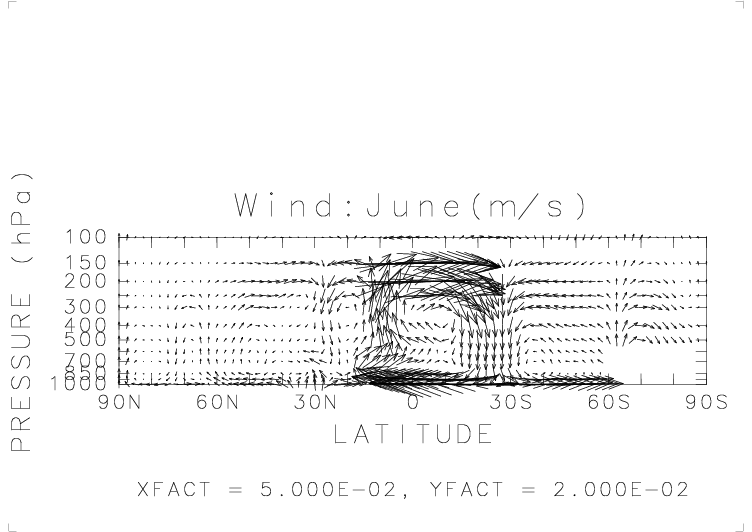
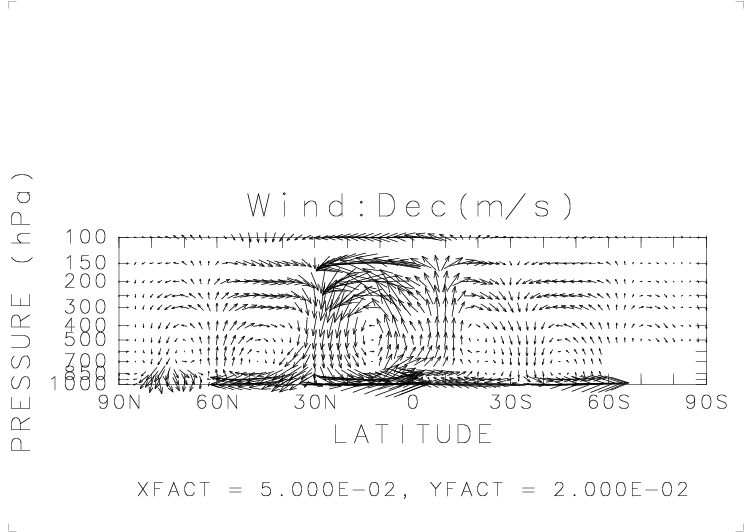
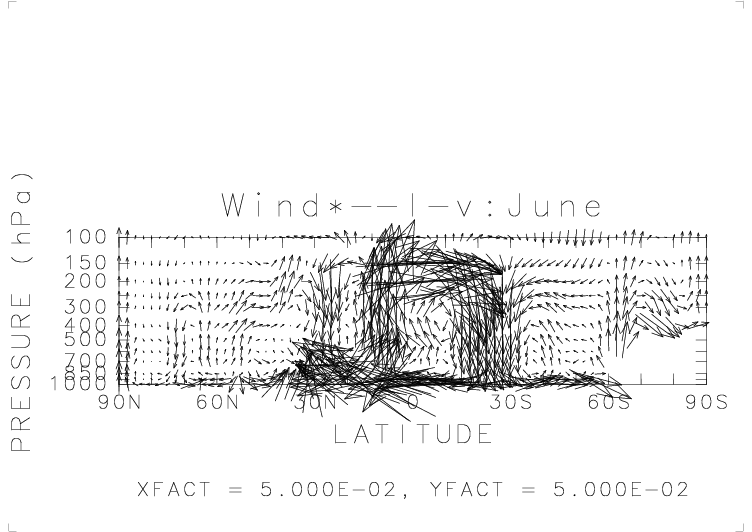
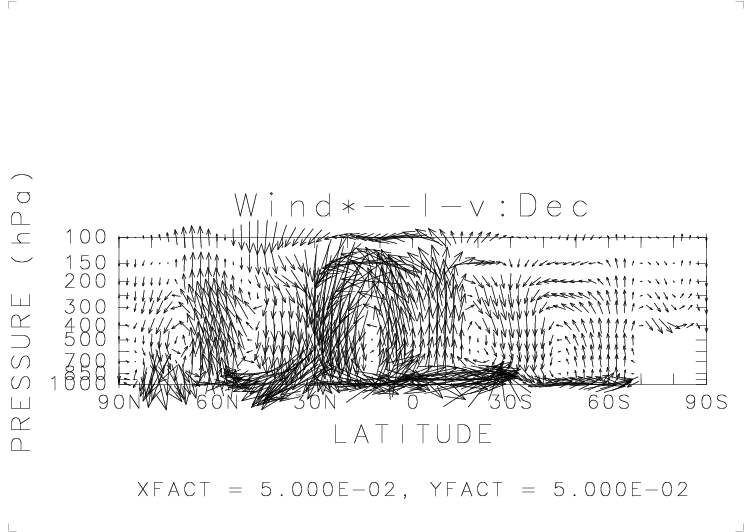
First, before I investigate the TEM (Transformed Eulerian Mean) circulation, I watched how the wind actually circulate on the earth.
The figures below is the wind velocity vector on the meridional in June and December.
Next, I focused on the TEM circulation. Here I did no adjustments. Since Sabunhou is used for the differencial terms,
at the end of the data, errors tend to be big. The figures are for June (upper) and December (lower).
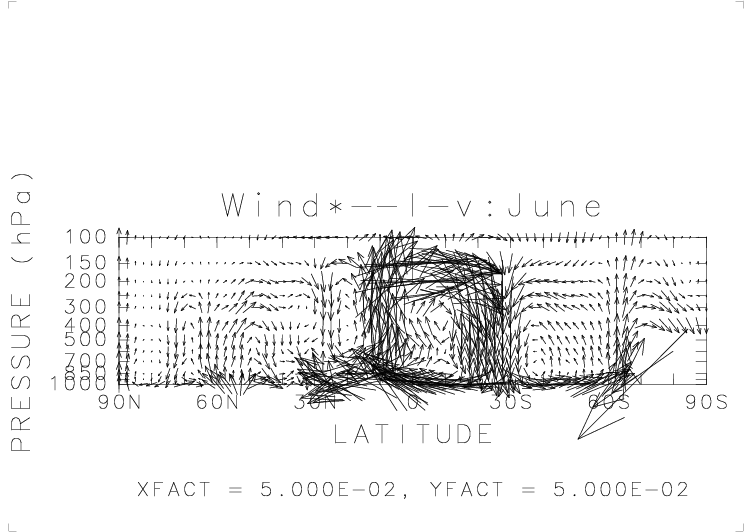
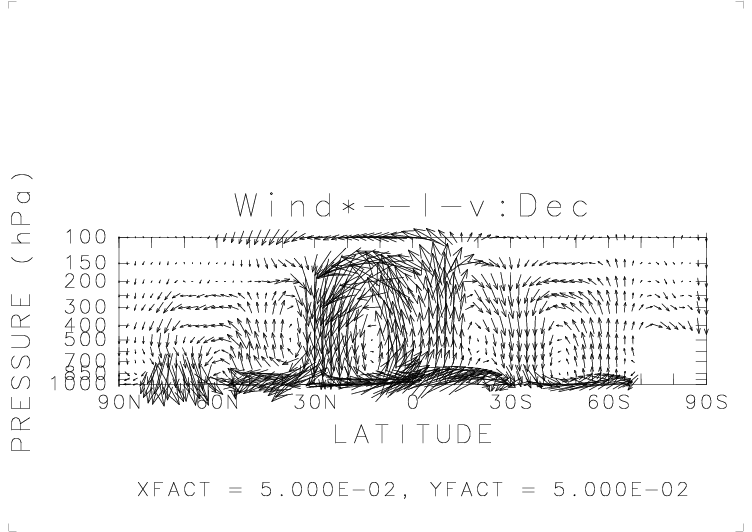
When I looked at the figures above, it seemed to me that the wind is not circulated,
I doubtd that the diffrencial term did not work well.
Therefore, using the three order spline -----, I redicided the differencial terms and drewed the figures below.
They are also for June (upper) and December (lower).
I tried to draw the EP Flux using the three order spline ----. These are too for June (upper) and December (lower).
To reveal the dependence on seasons, I show the TEM circulation below for March (upper) and September (lower).
¦ I produced a lot of figures for other meteorological variables. Please watch them from here.
Comparing the picture of the actual wind to that of mean residual circulation, there is little difference in tendency at any latitude and at any height in June,
but their appearences differ greatly in mid-latitude in the Northern Hemisphere. In the actual wind circulation, at around 60‹N
there is the upward-wind region, while at around 30‹N and 80‹there are the downward-eind regions. However, in the TEM picture,
an air parcel which fall down around 30‹N goes northward before arriving at the ground and rise once again at around 40-60‹N,
falling down at 70-80‹N. This motion is not to be seen in the actual circulation picture.
I want to see how the mean residual circulation will change depending on the season, I tried to draw the picture of March and September.
Please take a look at the comparison to the actual circulation from here.
I have also prepared for th slide show for every month TEM circulation. Please click here and watch it. If you want to watch
the slide show of EP flux, please check from here.
Caution!: When you watch the slide show, please wait for about one minute.
If you want to return to this screen, you can return only from the January slide.
Moreover, I hear that there is a software that can trace an air parcel. Though I had no time to use that software, I want to
see if an air parcel really moves in this manner.
I mentioned "the slide pattern" and "pressed pattern" in May. As for the TEM circulation, it is not true neither of them. I also want to know what on earth fundamentally drives this motion.